Why two-dimensional solutions were not enough
Electric drives, but also purely electronic devices, heat up during operation. This causes the air inside to expand. As it cools, it contracts again. The extruded cables are not bonded inside their sheath but lie loose. Through them, moist outside air can be drawn in as the unit cools. Over time it accumulates and leads to failures. A pressure equalisation element is meant to balance out the resulting pressure difference.
Conventional elements work two-dimensionally, that is, in a single plane. If such an element faces upwards and water under pressure hits it, the water gets into the lateral slots and stays there. This impairs the function of the membrane. The customer therefore already mounted the elements in a fixed orientation at the factory, always facing downwards. But drops formed and clung there too. What was needed was a three-dimensional solution that works regardless of the mounting position.
The three-dimensional solution
Friedrich Joerg worked on this task for around ten years. An initial approach in the form of a truncated pyramid open on four sides worked in principle, but repeatedly came loose when exposed to cleaning agents. At the same time, the element had to become ever smaller because of neighbouring connectors.
Numerous variants using ultrasonic welding did not achieve the goal either: the repeat accuracy required when joining the components could not be achieved, so the requirements could not be met reproducibly.
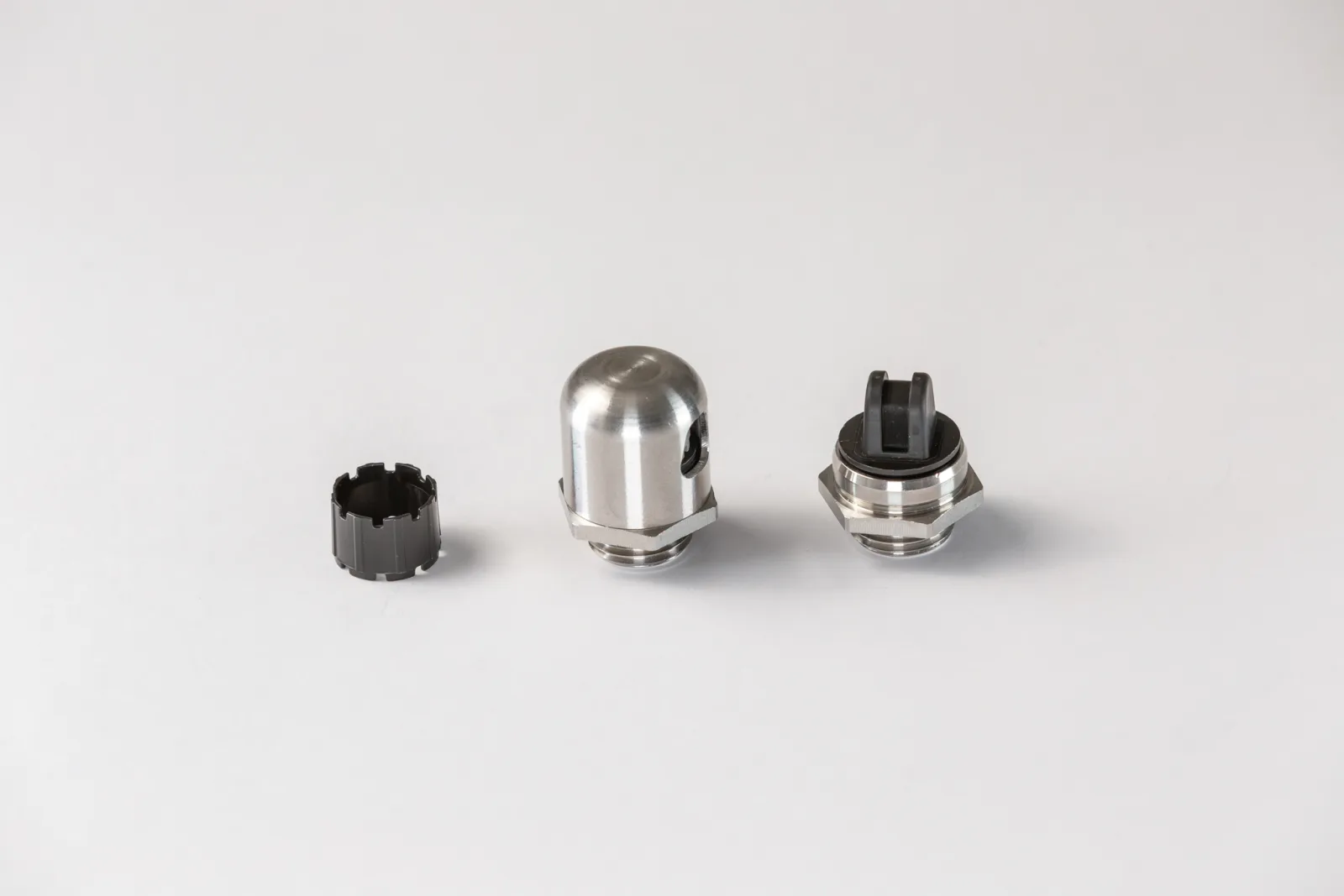
The eventual solution is a three-dimensional membrane in the shape of a small U. In every mounting position, one area remains free. To achieve this, the membrane is placed on a screw-in carrier part and overmoulded with thermoplastic elastomer. This demanding process delivered the first reproducible results. In the version with a stainless steel housing, the upper O-ring then turned out to be the critical point, not the membrane. A second sealing element beneath it, a washer, solved this problem.
From pressure testing to field trials
For cleaning, 60 bar from a distance of 1.60 metres was initially specified. The actual test used 100 bar from 15 centimetres, five nozzles and a rotating component. With the additional sealing element, the component passed the test.
“The test used 100 bar from 15 centimetres, five nozzles and a rotating component.”